“Come to the beach—NOW!”
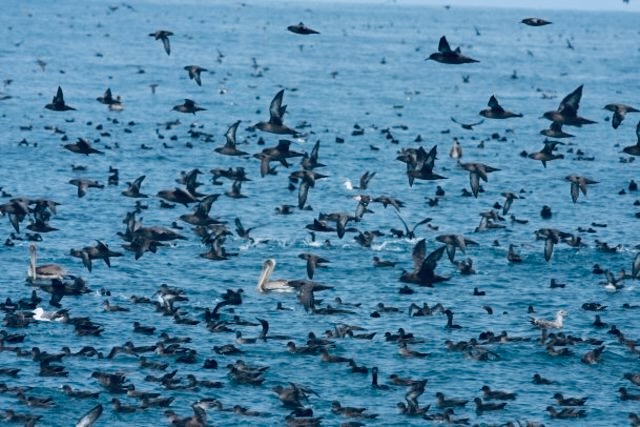
I scan the urgent texts from neighbors and naturalists and bolt out the door. Racing over the dunes, I hear a cacophony of squawks, bleats and cries. Then I see the birds—thousands swirling in great swooping waves, wing to wing, their dark feathers blotting the sun, their sleek bodies wheeling over the sea.
“It looks like something out of Hitchcock,” an onlooker says.
In fact, a scene like this one occurred not far from the director’s house on the Central Coast a few months before he started shooting The Birds. On August 18, 1961, masses of crazed birds invaded the town of Capitola, colliding into buildings and smashing onto cars. Frightened residents ran for shelter as dead and dying birds plummeted from above.
Hitchcock, who had recently acquired rights to Daphne du Maurier’s chilling novella, worked details of the avian attacks into his script, created new characters and relocated the drama to Bodega Bay, 140 miles north of Capitola. He cast seagulls, ravens and crows —some wild, some trained, many mechanical—as the feathered terrorists. But the vast majority of birds in the Capitola blitz and the feeding frenzy I witnessed came from far, far away.
 Sooty Shearwaters, sturdy seabirds with dark-chocolate coats and silver patches under their wings, don’t look intimidating, but they are impressive. Every year these oceanic nomads undertake one of the longest migrations in the animal world. From their breeding grounds in New Zealand, they trace enormous loops around the Pacific that can total 40,000 miles. Holding their wings stiff and straight, they glide with the wind, dipping from side to side so low that they appear to “shear” the water.
The ultra-marathoners follow the bounty of the sea. In Northern California, the seasonal upwelling pumps cold nutrient-rich water toward the surface, fueling a food web that can concentrate millions of anchovies along the coast. When the small fish cluster into massive bait balls, the shearwaters dive into their midst. Other hungry birds—pelicans, common murres, cormorants—as well as sea lions and humpback whales rush to gorge on the floating feast. Their churning makes the water look like it’s boiling.
The scene is spectacular, not scary. So what caused the bloody maelstrom in Capitola? For half a century, no one knew what had literally gotten into those birds. In 1991, after more than 150 pelicans and cormorants died in nearby Monterey Bay, investigators discovered that they had eaten anchovies laden with domoic acid, a potent neurotoxin produced by certain microscopic algae that can cause disorientation, seizures and death.
A few years later, scientists reopened the Capitola cold case. Examining preserved samples of plankton collected in Monterey Bay in July and August of 1961, they found an abundance of toxin-producing algae. Domoic acid could not be proved guilty beyond doubt, but the evidence pointed strongly toward it as the likely culprit.
In the decades since, the ocean-spanning travelers have come to seem more vulnerable than villainous. Once Sooty Shearwaters flew in such immense flocks that they darkened the sky. In recent decades, their numbers have dwindled as warming and changing oceans alter their food supply and other pressures take their toll.
Hitchcock’s birds became stars of an iconic thriller. But I will never forget a greater thrill: the awesome sight of thousands of Sooty Shearwaters sweeping over the sea, halfway around the world from home, on one of the most remarkable journeys on Earth.